

Advanced Materials Development & Engineering Services
-
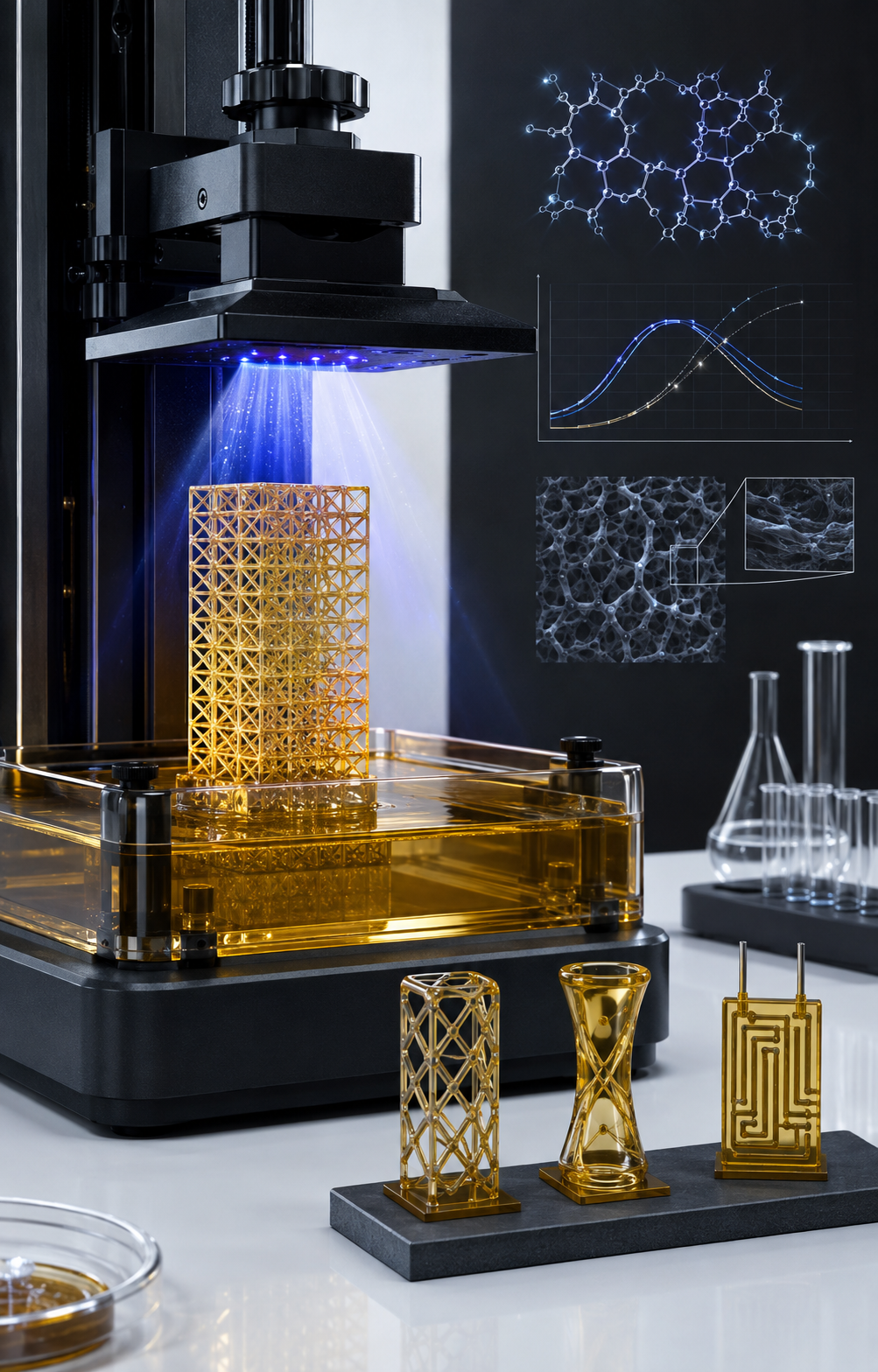
Custom formulation and validation of high-temperature, flame-resistant, shape-memory, self-healing, and electrically functional polymer systems for demanding industrial applications.
-
SLA/DLP process development, 3D/4D printing, prototype fabrication, and validation of printability, dimensional accuracy, repeatability, and end-use performance.
-
Thermal, mechanical, rheological, electrical, and microstructural characterization to evaluate material performance, processing behavior, reliability, and suitability for demanding applications.
Self-Healing Materials in Action
Infrared thermography showing heat distribution during thermally activated material recovery.
© 2026 Konbells 4D Technologies, LLC. All rights reserved. Unauthorized reproduction, distribution, or reuse is prohibited.
An electrically conductive composite laminate generates heat internally when electrical current is applied. This Joule heating activates dynamic covalent-bond exchange within the covalent adaptable network (CAN), allowing the polymer network to rearrange across damaged interfaces and repair cracks while retaining its crosslinked structure. The process enables localized, remotely activated self-healing and supports recovery of the laminate’s structural performance.
Shape-Memory Materials in Action
A 3D-printed shape memory polymer coil rapidly recovers its original geometry when immersed in hot water, demonstrating programmed, heat-activated shape restoration.
A shape-memory polymer composite gradually recovers its original geometry at roomtemperature, demonstrating autonomous shape restoration without external heating.
© 2026 Konbells 4D Technologies, LLC. All rights reserved. Unauthorized reproduction, distribution, or reuse is prohibited.
Flame-Resistant Materials in Action
Konbells develops multifunctional polymer composites engineered to resist ignition, limit flame propagation, and reduce continued burning after the ignition source is removed. Phosphorus-containing components promote protective char formation, helping insulate the underlying material and slow heat and mass transfer during flame exposure.
The first video on the left demonstrates the self-extinguishing behavior of a shape-memory polymer sample following a 10-second vertical flame exposure. A visible protective char layer begins to form within seconds of ignition. The same sample is then exposed to the flame a second time for approximately 65 seconds. The resulting char layer acts as a protective barrier, limiting flame propagation and the release of combustible volatiles. Once the ignition source is removed, the sample self-extinguishes almost immediately.